Boring Tavern? Here is the Fix

A Tavern Should Already Be in Trouble When the Characters Arrive
Too many tavern scenes are neutral containers. They are places to receive quests, overhear rumors, and maybe meet somebody interesting. That works, but it usually leaves a lot of interesting play sitting on the table.
Taverns are typically the launchpad for an adventure but a lot of GMs have not fully built the tavern interaction out.
They don't need more lore.
They don't need more occupants.
They don't need an innkeeper with a hidden royal bloodline.
They don't need a bartender with a ten page backstory about a war.
Taverns are underbuilt because too many tavern scenes are neutral. Bland containers waiting for the players to poke around.
Too often GMs allow them to be places where the party can stop, breathe, receive a quest, overhear a rumor, get into a bar fight or drink and gamble the night away.
All of that works but it could also be so much more.
Just like a good story starts with the action or starts when things go wrong, a tavern can follow that same path. The tavern comes alive the moment it is already in trouble when the players arrive.
Not necessarily "on fire" trouble.
Just active trouble.
You know that job board posted outside the inn that has 3 or 4 adventures waiting for the party to decide to take on?
What if some of those "jobs" were already in motion inside or around the tavern?
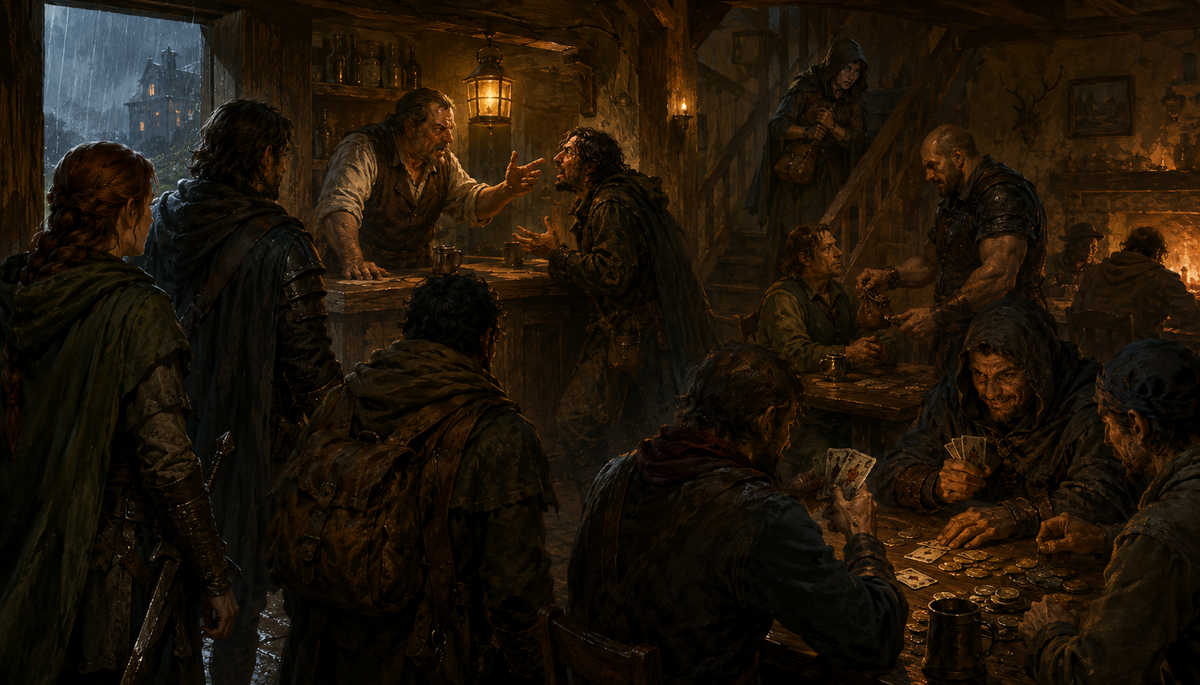
A debt just came due that morning.
A regular customer who has gone missing.
A card game that somebody is clearly fixing.
A local gang collecting protection money.
A frightened courier who picked the wrong place to hide.
The tavern should already be in motion (not waiting for the characters to arrive).
That changes the whole feel of the scene.
Now the tavern is not a waiting room before the adventure.
It is the adventure. Or at least, it is a part of the adventure.
That matters because taverns are one of the easiest places for the GM to smuggle pressure into a campaign without making it feel artificial.
Everybody wants something in a Tavern.
People owe money.
People want privacy.
People want information.
People want witnesses.
People want to be seen.
People want to avoid being seen.
People are celebrating too early.
People are hiding injuries.
People are looking for someone desperate enough to say yes.
That is a lot of playable material before the characters even leave the room.
Once you start thinking of the tavern as a great pressure point instead of an automatic quest dispenser, a few things happen fast.
First, the players have more honest choices while immersed in the game, not making a dry choice from a job board.
The players can intervene.
The players can exploit.
The players can negotiate.
The players can walk away and let the situation play out.
The players can back the wrong person.
The players can make a small private problem public.
Any of that is better than "do you talk to the hooded figure in the corner?"
Second, the GM has less dead air to fill.
If the tavern already has a conflict, a debt, a lie, or a clock running, then the scene can move and play out even if the players hesitate or do nothing.
Somebody storms out.
Somebody gets accused.
Somebody upstairs trips and falls.
Somebody rings for the watch guard.
That motion is useful.
It means the scene does not rely on the characters asking the exact right question before anything becomes interesting.
Third, rumors become more meaningful.
If a rumor is attached to an active problem it is not just color, but has meaningful impact.
It is leverage.
Which has more impact, the Rumor or Scene?
Rumor: "The ferryman has not been home in two days."
Scene: The sister of the ferryman is crying and arguing with the innkeeper over a bar tab that the ferryman has not paid.
Rumor: "The shrine bell has started ringing at dusk with no one around."
Scene: A soaked traveler is complaining loudly to anyone who will listen that he heard the shrine bell at dark and refuses to make the return journey alone.
Now the rumor is not waiting to matter later. It matters in the room right now, in front of the characters faces.
So, if you have a job board, take at least one of those jobs and turn it into a scene playing out in front of the characters. Or if you are ambitious, have multiple scenes play out in the tavern over the course of an evening of character drinking and let the players chose the ones they want to become involved with.
If the taverns in your game feel flat, start there.
Do not add more patrons with more backstories.
Add a problem (pressure) that was already happening before the party walked in.
Most of the time, that is the change that turns a stop on the road into a real situation.
Before your next tavern scene, write down one active problem that started before the players arrived and one way it gets worse if the party does nothing. That is usually enough to make the whole room feel more alive.