Critical Hits and Bad Misses for Shadowdark
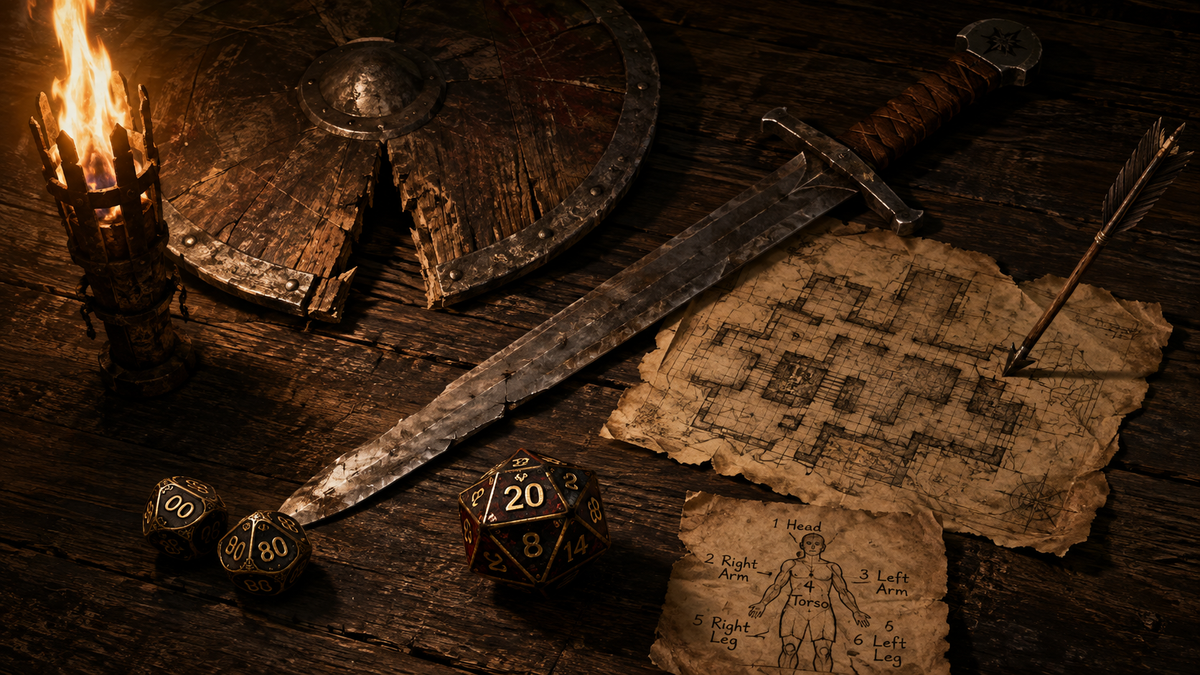
In combat, when someone rolls a natural 20, they get excited, the mood shifts around the table. It shouldn't end there with another, possibly disappointing, damage roll.
A natural 20 should change the fight, become cinematic, memorable.
Maximum damage is satisfying. A critical hit gets more memorable when it also changes someone’s footing, grip, nerve, gear, or ability to keep fighting.
I created d100 critical-hit and critical-miss tables that keep the speed of Shadowdark combat while giving natural 20s and natural 1s consequences the whole table can picture and enjoy.
First link is a PDF, second link is an automated tool that requires a Chatgpt account.

I have treated a natural 20 as a critical hit and a natural 1 as a critical miss for more than forty years.
The exact result has changed from game to game, but the basic idea has stayed with me: when that number comes up, everyone at the table should feel it.
For a critical hit, my starting rule has always been simple. Do not roll damage. Deal the weapon’s maximum damage and add the normal bonus.
That already feels good. It avoids the disappointing critical hit that turns into two miserable damage dice. It is fast, definite, and easy to remember.
But maximum damage is still only a number and can be boring.
A truly memorable critical hit usually does something to the narrative of the fight.
The blow drives an enemy away from the doorway.
A shield strap is cut loose.
An arrow pins a cloak to the wall.
A hammer knocks the breath out of someone.
Blood gets in a creature’s eyes.
A nearby hireling hears the crunching impact and decides this is no longer a job worth dying for.
That is the idea behind Critical Hits and Bad Misses for Shadowdark.
It is a set of four d100 tables:
Slashing critical hits.
Blunt critical hits.
Missile and thrusting critical hits.
Critical misses.
The numbers escalate, the higher the percentile roll the worse the situation gets, but the main purpose is not to turn combat into arithmetic. The purpose is to make an exceptional roll leave the battlefield in a different state. The dynamics of the battle can suddenly shift.
Why build this for Shadowdark?
I shifted to using the lighter, leaner Shadowdark ruleset but was still stuck using an outdated critical hits and misses system.
Shadowdark already understands that danger works best when everyone can see it.
Combat is quick. Distances are simple. Advantage and disadvantage do a lot of work without requiring a pile of modifiers. Morale means a fight can end because creatures flee or surrender, not only because every enemy has been reduced to zero hit points. Gear matters because what a character carries matters.
Those are exactly the pressure points I wanted the critical tables to use.
Most results do not introduce a new condition or a separate tracking system. They use things the table already understands:
- advantage or disadvantage on the next attack;
- movement limited to close;
- a dropped weapon or damaged gear;
- a lost action, move, or reaction;
- a morale check;
- a familiar DC 9, 12, or 15 check;
- a body-part injury that has an obvious narrative effect.
The aim is to read the result, make one sensible ruling, and continue moving around the table.
If a critical table makes us stop the fight so we can study the critical table, it has failed.
The first quarter needed to do more than nothing
My old mental version of the critical-hit chart began with a broad low band where no additional effect occurred. The attack still dealt maximum damage, so it was not wasted, but the percentile roll sometimes felt like a second roll that had failed to produce anything.
That was the first thing I wanted to improve.
On these tables, results from 01 through 25 keep the original maximum-damage rule and add a small positive effect unrelated to extra damage.
A slashing weapon might open the target’s guard, force it to drop something, or frighten an enemy into a morale check.
A blunt weapon might stagger the target, spoil its next attack, or knock it off its feet.
A missile or thrusting weapon might pin something, reveal an armor gap, or give the attacker time to duck behind cover.
These are intentionally useful without being catastrophic.
The critical hit always gives the player a little more battlefield authority. Even the lowest percentile result impacts the combat and moves the situation.
The middle bands keep my old escalation
The damage progression preserves the older structure:
- 01-25: maximum weapon damage, plus a minor advantage;
- 26-50: double maximum weapon damage, plus a stronger disruption;
- 51-75: triple maximum weapon damage, plus a serious combat consequence;
- 76-100: escalating damage and a severe body location result.
Only the weapon’s maximum damage is multiplied. The character’s ability modifier is added once.
For example, a 1d8 weapon with a +2 modifier deals 10 damage on an ordinary maximum-damage critical, 18 on a double-maximum result, and 26 on a triple-maximum result.
That keeps the arithmetic quick and prevents a high ability bonus from ballooning several times.
The damage becomes frightening in the upper half of the table. That is deliberate. A natural 20 is uncommon, and the most extreme percentile results are rarer still. When someone rolls one, it should sound different at the table.
Why separate the weapon types?
I did not want three tables that changed only the descriptive verb.
A sword, hammer, and arrow should create different problems.
Slashing weapons interfere with guards, straps, armor, limbs, and confidence. Their results often create openings or force enemies to drop what they are holding.
Blunt weapons control footing, breath, balance, shields, and consciousness. They push, stagger, knock down, and break.
Missile and thrusting weapons exploit lines and narrow openings. They pin, impede movement, punch through weak defenses, and occasionally threaten something directly behind the target.
The distinction is not a physics simulation. It is a fast source of fictional direction.
When the result says “weapon bind” or “driven back,” the GM and player immediately have something to describe. The chart does part of the imaginative work without dictating an entire scene.
At 76 and above, anatomy enters the result
The upper quarter uses a second roll (1D6) for hit location:
- left leg;
- right leg;
- left arm;
- right arm;
- torso;
- head.
That six-part model is deliberately broad. It works for a person, but it is also easy to translate. Wings can replace arms. Forelegs can replace human legs. A serpent’s body can be divided into forward and rear sections. A floating horror might replace limbs with eyestalks or grasping tendrils.
The body location tells us what part of the creature’s ability to act has been threatened. The percentile result tells us how long or how severely.
This is also where common sense has to overrule the printed result.
A dagger cannot decapitate a giant because someone rolled 100. A skeleton does not bleed. A slime does not drop the sword it was never holding.
Keep the damage, then translate the impossible effect into something that fits the scene: lost movement, a broken defense, a severed strap, a damaged sensory organ, a dropped victim, or a lost action.
The chart is there to help the ruling. It is not there to defeat it.
Bad misses should create trouble, not resentment
Critical misses are more difficult to design than critical hits.
A critical hit gives a player an unexpected reward.
A critical miss takes control away at the exact moment the player was already unsuccessful. If every natural 1 breaks a favorite weapon, injures an ally, or permanently damages an ability, the table can become punitive very quickly. GM's and players want cinema, not a beatdown.
So the critical-miss table climbs in stages.
Low results create a movement tell, an overreach, a bad step, or a loose grip. The character may give an enemy advantage, lose a reaction, or need to reset their grip on their weapon.
The next band attacks position and supplies. A weapon falls close. A piece of kit spills. Something fragile breaks. The character becomes snagged or exposed.
Higher results can knock the character prone, cause a collision, deal weapon damage to the fumbling attacker, threaten a nearby ally, or break a mundane weapon.
The rarest results reach temporary and lasting injuries.
I kept permanent ability loss as an optional Grim Injuries rule.
Shadowdark characters already live close to danger, and a five-percent chance of rolling a natural 1 is much too frequent for every miss to threaten permanent stat damage. On the finished table, the possibility sits only at the extreme end of a d100 roll, includes a saving check, cannot reduce an ability below 3, and can be repaired through meaningful downtime, powerful magic, or a recovery quest.
Most importantly, the GM should tell the players before the campaign whether Grim Injuries are in play.
Surprise is good inside the narrative of the story. Surprise about the campaign’s injury rules is not.
Should monsters use the tables too?
They can, but I would not begin there.
My recommended default is to let player characters and important named foes use the critical tables. Ordinary monsters still benefit from the normal critical rule your table uses, but they do not all stop combat for a percentile roll.
This keeps the special results special and limits how often severe injuries land on the player characters.
If your group wants a harsher campaign, let every creature roll.
If your group wants the colorful tactical results without the maiming, cap all percentile rolls at 75. You still get dropped weapons, shattered supplies, morale breaks, forced movement, and sudden openings. You simply remove the lasting-injury end of the system.
That is one of the things I like about the finished structure. The danger can be tuned without rewriting the tables.
A quick example at the table
A fighter rolls a natural 20 with a longsword.
The sword deals its maximum weapon damage plus the fighter’s modifier. The player then rolls 38 on the slashing table: Weapon Bind. The hit deals double maximum weapon damage, and the target has disadvantage on its next melee attack.
That is already more useful than “the number is bigger.”
The fighter has hurt the enemy, changed its next decision, and perhaps created room for an ally to act.
Later, an enemy archer rolls a natural 1. The GM decides this named foe uses the critical-miss table and rolls 33: Spilled Kit. A mundane item in an easy-to-reach slot falls close.
The GM rules that the archer’s signal horn drops onto the ledge.
Now the miss has created a choice. Does the archer recover the horn, keep shooting, or retreat before someone else grabs it? Can a player reach it first? What happens if the alarm is never sounded?
The chart did not write the answer. It gave the fight a new object and let the table decide what it means.
That is what I wanted from this system.
Use the chart, then get back to the fight
Critical Hits and Bad Misses is not meant to make Shadowdark combat slower or more technical.
In fact there is often not even an extra roll. Shadowdark has players roll multiple damage dice on a critical hit.
For my system, max damage is automatic, I just substituted the Shadowdark extra damage roll for a critical hit roll using percentile dice.
It is meant to make the rare, loud rolls create an impression.
Maximum damage makes the roll satisfying.
The consequence is what makes everyone remember it.
Try the interactive Critical Hits and Bad Misses tool:
Automated Tool - requires Chatgpt account https://critical-hits-bad-misses-shadowdark.brainamp.chatgpt.site
PDF printable charts -